
Glossary
A glossary of key OOH terms.
Assets
The term generally used to describe the creative files that run as part of an OOH ad campaign. Variously, also described as 'creative', 'artwork' or 'copy'.
Creative files are generally image files (file format: JPG) or video files (file format: MP4 or MOV).
File types can vary for dynamic campaigns (see below).
Aureus
WPP Media's campaign planning tool; formats and dates are added to Aureus to generate estimated audience impact figures via Route; these forms the basis of the media plans we receive for setting up campaigns
Cover
The proportion of the target audience who are exposed to the campaign and a key metric used to track and analyse OOH campaign performance.
Creative agency
A company and key stakeholder in the OOH campaign process that creates and delivers creative assets.
Domination
A 'domination' booking is when a campaign runs at 100% Share of Time (SoT) section. for a specific duration.
This means that only this campaign runs for the specified duration, i.e. no other adverts appear alongside it. Domination bookings are the exception and generally booked as part of special events or activations, e.g. 'roadblocks'.
Dynamic
A specific type of OOH campaign in which content changes based on some kind of external data source or trigger, e.g. location or weather, without the need to supply new content to the media owners.
In practice, dynamic campaigns are delivered via special file formats (dynamic files) that allow for these mid-campaign changes - mainly HTML. The media owner schedules in these dynamic files once and thereafter, DOOH.com's team can manage and publish new content.
Formats
The term generally used for digital OOH screen types operated by media owners. Note that ‘format’ refers to a unique type of screen rather than
specific/individual screens, which are generally referred to as 'frames'.
Frames
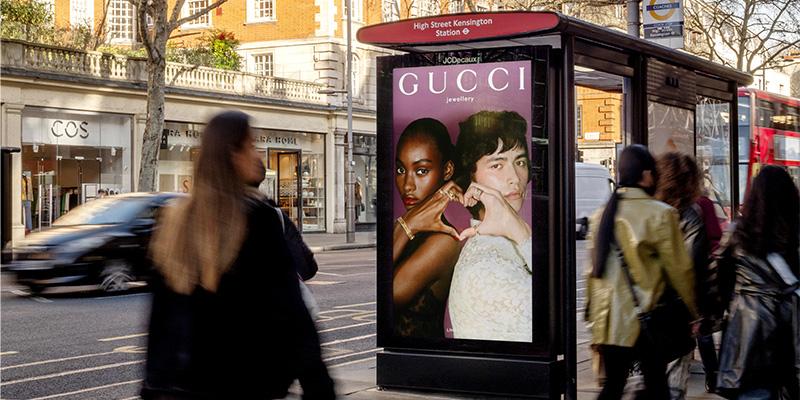
The term generally used for specific, individual OOH screens, which fall under a 'format' (see above). In the UK, the majority of frames are uniquely identified by an ID called a Route Frame ID.
For example, the below shows a specific frame outside of High Street Kensington station that is part of JCDecaux's Roadside D6 format.
Frequency
The average number of times those exposed to the campaign will see it and a key metric used to track and analyse OOH campaign performance.
Impacts
The total number of times the target audience sees the campaign and the primary metric used to track and analyse OOH campaign performance.
K Number
The unique identifier used for WPP Media's campaigns for accounting purposes, e.g. K61245. The 'K' refers to the fact that WPP Media used to be called Kinetic.
In general, the K Number is the shared reference point across all stakeholders when working on OOH campaigns for OOH Media.
There are two exceptions:
- If a campaign is running on airport OOH formats, the unique identifier is called an 'AV Number', e.g. AV04254
- If a campaign is programmatic, the unique identified is called an 'IO Number'
Linear
OOH assets that are either image (e.g. JPG) or video files (e.g. MP4). Campaigns that run as 'linear' involve the Verify team trafficking image/video files to media owners for scheduling. Linear assets can also be referred to as 'non-dynamic', as once scheduled in by media owners, they will not change during the campaign unless any assets are resupplied.
Loop duration or length
This refers to the duration in seconds of one 'loop' of ads.
In general, OOH formats have a maximum number of available slots within a loop. For example, Global's Streethub has a standard loop duration of 60 seconds, which includes 6 x 10 second slots.
This means that Streethub can only run a maximum of 6 different campaigns at any one time; if maxxed out, essentially this format has been sold out.
Media owner
The owners and operators of digital OOH screens; creative is trafficked to media owners to schedule onto screens; media owners also provide us with playout reports. Often abbreviated to 'MOs'.
Examples: JCDecaux, Clear Channel, Global Outdoor, Ocean Outdoor, Alight Media
Planner
The term generally used for the WPP Media OOH team with whom we work on campaigns.
Planners plan OOH campaigns, which means identifying specific formats and frames to run on in order to achieve specific audiences.
POP or Proof of Play
The term used to describe a photo (or video) of a campaign playing on a real world screen (to prove that it is playing out).
Reach
The unique number of individuals seeing the campaign and a key metric used to track and analyse OOH campaign performance.
Route
A dataset that estimates the number of audience ‘impacts’ for individual OOH screens at different times. Campaign planners use Route to estimate how many impacts can be achieved for clients; the Verify system maps media owner playout reports to Route to indicate how many impacts have been delivered.
Route is managed by Outsmart, an UK OOH industry body of which media owners and major agencies (including WPP Media) are a part.
Share of Time (SOT) or Share of Voice (SOV)
The % share of time that a given ad campaign displays across a standard format loop length.
For example, Global's Streethub format has a standard loop length of 60 seconds. A campaign is generally booked to run at 16.67% SoT for this format, which means that in any given 60 second loop, the campaign will display for 10 seconds (10 divided by 60 seconds = 0.167, i.e. the 10 second 'spot' is 16.67% of the total available loop length).
SoT is calculated as =
Format slot length ÷ format loop length x 100%
Signage or scheduling software
The variety of software used by media owners to schedule in any content provided (whatever campaign type).
Slot duration or length
This refers to the duration in seconds of a specific OOH ad being displayed, e.g. Global's Streethub format has a standard slot duration of 10 seconds and JCD's Roadside D6 format has a standard slot duration of 12 seconds.
Note that some media owners can run ads at non-standard slot durations upon request.
Targets
This refers to the estimated delivered plays or impacts for a campaign that should be achieved based on the booked formats and dates.
If a campaign delivers more plays/impacts than the estimate, it 'overdelivers'. If a campaign delivers fewer plays/impacts than the estimate, it 'underdelivers'.
Trader
The term generally used for the WPP Media OOH team involved with negotiating booking rates with media owners. In practice, DOOH.com doesn't have much contact with traders; all of our comms goes through the planning teams.
If a campaign underdelivers due to a media owner issue (e.g. a scheduling error or technical fault), the trading team will become involved to manage any compensation claims.
Trafficking
The term used to describe sending artwork to media owners for scheduling.